
Retirement Savings - 2027 Contribution Limits

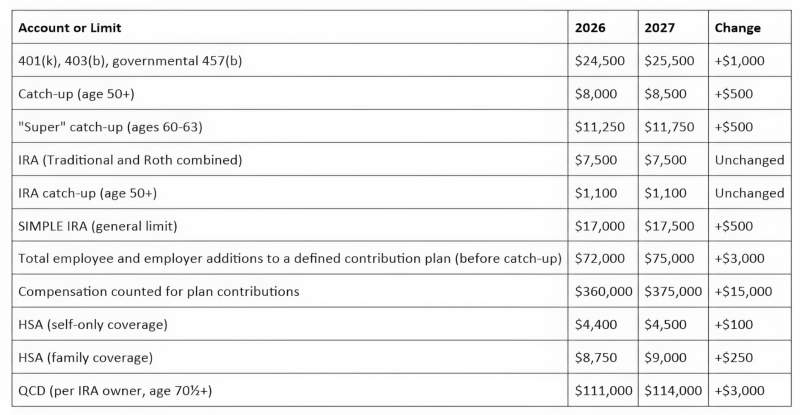
The IRS has released the 2027 contribution limits, and most savers get a little more room: the 401(k) deferral limit rises to $25,500, the catch-up for savers turning 60 to 63 increases for the first time, and the QCD limit climbs to $114,000. IRA limits stay at $7,500. Here are some notable items:
• The "super" catch-up finally rises: If you turn 60, 61, 62, or 63 during 2027, you can contribute an extra $11,750 to most 401(k), 403(b), and governmental 457(b) plans, up from $11,250 in 2025 and 2026. This replaces the regular $8,500 catch-up available to employees age 50 and older. For certain higher-income employees, catch-up contributions must be made on a Roth basis rather than pre-tax.
• The QCD limit increases to $114,000: A qualified charitable distribution (QCD) is a gift sent directly from your IRA to a qualified charity, available once you are 70½ or older. In 2027, each IRA owner can give up to $114,000 this way, up from $111,000. A QCD is excluded from your income, can count toward your required minimum distribution (RMD), and works whether or not you itemize.
• Turning 73 in 2027? Plan your first RMD: If you were born in 1954, your first RMD from a traditional IRA is for 2027. You can technically wait until April 1, 2028 to take it, but your 2028 RMD is also due by December 31, 2028, so two years of RMD income land in one tax year. For many people, taking the first one in 2027 keeps their tax bracket lower and can help avoid a jump in Medicare premiums. If you give to charity, a QCD can count toward your RMD.
• There is still time to finish 2026: Traditional IRA, Roth IRA, and Health Savings Account (HSA) contributions for 2026 can be made until the tax-filing deadline, which for most people is April 15, 2027. Payroll contributions to a 401(k), 403(b), or 457(b) work differently. They come out of your paycheck, so your last 2026 payroll is the practical deadline for any remaining 2026 room.
Below is a breakdown of the 2026 and 2027 limits for the most widely used accounts:
Other Things to Consider:
• Roth IRA eligibility depends on your income: For 2027, the ability to contribute directly to a Roth IRA phases out with Modified Adjusted Gross Income (MAGI) between $158,000 and $173,000 for single and head-of-household filers, and between $250,000 and $260,000 for married couples filing jointly (up from $153,000 to $168,000 and $242,000 to $252,000 in 2026). Above those ranges, some households use a "backdoor" Roth instead, making a nondeductible traditional IRA contribution and then converting it. If you already have pre-tax money in any traditional, rollover, or SEP IRA, the pro-rata rule makes part of that conversion taxable, so it's worth reviewing with your Portfolio Manager and CPA before acting.
• There is no age limit on IRA contributions: You can keep contributing as long as you (or your spouse, if you file jointly) have earned income. Reaching RMD age, which is 73 if you were born from 1951 through 1959 and 75 if you were born in 1960 or later, does not close that door on its own.
• Gifting and estate limits rise in 2027: The annual gift exclusion increases to $20,000 per recipient, up from $19,000. Gifts made through December 31, 2026, still fall under the $19,000 limit, and unused 2026 room does not carry forward. The lifetime estate and gift tax exemption rises to $15,480,000 per person, or $30,960,000 for a married couple, up from $15,000,000 and $30,000,000 in 2026. If your estate plan hasn't been reviewed in the last few years, this is a good time to revisit it with your estate attorney.
• Year-end is a natural time to check your IRA beneficiaries: Your IRA passes to whoever is named on the beneficiary form, even if your will says something different. A quick review now can make sure your savings go where you intend.
Talk With Your Portfolio Manager: If you'd like to review your retirement contributions, confirm your IRA beneficiary designations, or discuss how these updated 2027 limits fit into your overall financial plan, please reach out to your Portfolio Manager. Where a tax or legal decision is involved, we're happy to coordinate with your CPA or estate attorney. We're here to help you make the most of every planning opportunity!