The 530A "Trump Account": Giving Your Child a 60-Year Head Start

When thinking about saving for your child, college funds usually steal the spotlight. But there’s a new player in town: the 530A Account (often called the "Trump Account").
Created under recent tax legislation, the 530A is a first-of-its-kind savings account designed to give kids an early jump start on retirement.
If you're looking for fresh ways to build long-term wealth for your child, here’s the scoop on how 530A accounts work, who qualifies, and when to use one.
What Is a 530A Account, Exactly?
Think of a 530A as a long-term "wealth vault" for kids.
Unlike a regular IRA, your child doesn't need a job or earned income to get started. You can open one for a baby the day they get a Social Security number.
Here’s the basic journey:
- Ages 0 to 17: Money put into the account grows tax-deferred. To keep things safe and simple, investments are locked into low-fee U.S. index funds (like S&P 500 Exchange Traded Funds).
- Age 18: The year your child turns 18, the account automatically hands over the keys and transforms into a standard Traditional IRA in their name.
A Quick Note on Early Withdrawals: Because it turns into a Traditional IRA at age 18, withdrawing money before age 59½ usually incurs a 10% penalty. However, your child can take penalty-free early withdrawals for qualified higher education expenses or up to $10,000 for a first-time home purchase (though ordinary income taxes will still apply to the earnings).
Who Qualifies & How to Open One
- The Child: Any U.S. citizen under age 18 with a valid Social Security number qualify. (Each child can only have one 530A).
- How to Start: A parent or guardian claims the account by submitting IRS Form 4547 (either through their annual tax filing or online via TrumpAccounts.gov).
Free Seed Money & Contribution Rules
The coolest feature of the 530A? You don't have to fund it all by yourself.
- Free Charitable Gifts ($250): Thanks to a multi-billion-dollar gift from the Michael & Susan Dell Foundation (Invest America), qualifying kids age 10 or younger in eligible ZIP codes can score a $250 bonus deposit.
- Family & Friends Limit: Anyone can pitch in: parents, grandparents, aunts, or friends! Total private contributions are capped at $5,000 per year, per child.
- Employer Matches: Employers can pitch in, too! If an employer offers this benefit, they can contribute up to $2,500 per year tax-free toward an employee’s child’s 530A account. (Note: this counts toward the $5,000 annual limit.)
When Should You Use a 530A?
Because 530A funds are locked until adulthood, this isn't the account to use for next year's summer camp or private high school tuition. Instead, it shines in three big moments:
1. You Want to Play the Long Game (Supercharged Compounding)
Time is a kid's greatest asset. If you put away just $1,000 a year from birth through age 17 ($18,000 total out-of-pocket), the account could reach roughly $37,450 by age 18 assuming an 8% average return. If your child leaves $37,450 untouched in their IRA until age 60, that conservative 8% compounding will grow this single starting nest egg into over $940,000!
2. You Want to Protect College Financial Aid
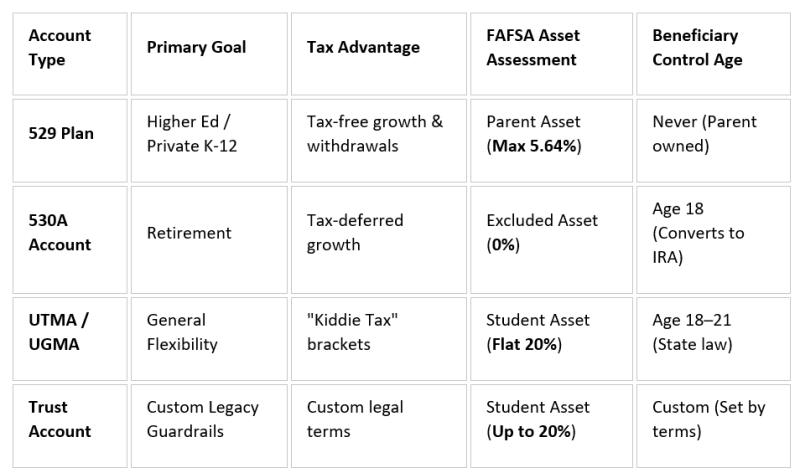
With standard custodial accounts (like Uniform Transfers to Minors Act or Uniform Gifts to Minors Act), the government penalizes your child's federal student aid (FAFSA) eligibility by assessing the balance at a steep 20% rate. 530A accounts are treated as retirement assets, meaning they are completely ignored (0%) on the FAFSA asset calculation.
3. Your Employer Offers a Match
If your job offers a 530A match for employees with kids, take it! It's literally free money working for your child's future.
The Takeaway
Think of the 530A not as a replacement for college savings, but as a multi-decade head start. By opening one early, you give your kid an 18-year runway of compound growth before they even earn their very first paycheck.
While the Section 530A account is a new vehicle to fund your child’s future, remember that you have options. There are four primary account types available to save and invest for your children; some or all may be the right solution for you: