
SpaceX: An Otherworldly Bet on Musk, Inc.
SpaceX is expected to go public under the ticker SPCX on June 12. They will be selling 3.3%-4.3% of their shares and hope to raise around $75 billion. This suggests a total company valuation of $1.7 - $2.3 trillion ($75 billion divided by 0.043 or 0.033). Let’s take the midpoint and call it $2 trillion.
Here’s what their income statement looked like the last two years:

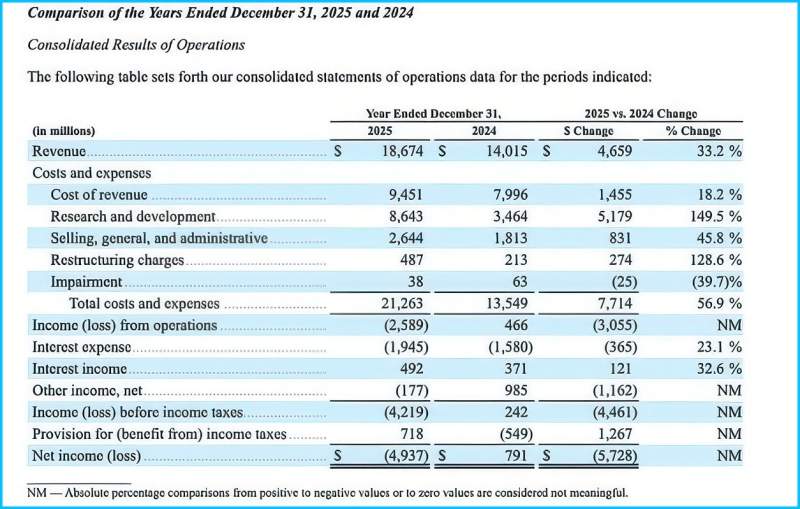
In 2025 SpaceX lost almost $5 billion on $18.7 billion in revenue. We obviously can’t do a price-to-earnings (P/E) ratio on SpaceX because it has no earnings, but we can do price-to-sales (P/S) on revenue. $2 trillion / $18.7 billion is 107. A P/E of 107 would be an extraordinarily expensive valuation for any company. A P/S of 107 is, however, in another galaxy. This is like paying $1 million for a local business that generates just $9,000 in revenue while making thousands in losses. The amount of growth and operating improvement required to obtain a reasonable return on such an investment would be almost beyond comprehension.
Following the merger with xAI – Elon Musk’s Grok AI model and the X social media site (formerly Twitter) – SpaceX now consists of three separate segments:
1. Space (launch services and NASA contracts) – This business will do about $5-$6 billion in revenue this year but produce fairly significant operating losses ($2-$3 billion) due to high R&D and capital equipment spending.
2. Starlink (satellite internet broadband) – This division could hit $20 billion in revenue in 2026 and an exceptional $7 billion in operating profits. This is the crown jewel of SpaceX’s businesses.
3. xAI – Expected to make perhaps $10 billion in revenue this year ($6 billion of which is from a recent deal to provide another AI company, Anthropic, with computing power) but with $10 billion in operating losses due to the massive costs of training and operating a frontier generative AI model that competes with OpenAI’s ChatGPT and Anthropic’s Claude.
While xAI’s operating losses will be around $10 billion, its cash flow is expected to be much worse at negative $20-$25 billion. xAI will spend at least $30 billion this year buying semiconductor chips and building data centers, but under standard accounting rules that massive cost doesn’t get expensed immediately on the income statement. Instead, it gets capitalized on the balance sheet and depreciated over a period of years. xAI’s massive cash drain is undoubtedly the impetus behind SpaceX’s desire to raise $75 billion in an IPO.
So, overall, SpaceX might bring in $35 billion in revenue this year while producing at least $10-$15 billion of operating losses. Is that worth $2 trillion? I’ve heard it said that the product of Elon Musk’s other major company, Tesla, is not actually electric cars but the stock itself. Since 2023 Tesla’s car sales have consistently declined while its revenue has flatlined, yet the stock has risen substantially and is now valued at $1.57 trillion. That’s an extremely high price for a company that hasn’t been growing and that’s expected to earn just $7-$8 billion in profits this year (200 P/E). By comparison, the stock market values META (formerly, Facebook), similarly at $1.54 trillion. This year META is expected to earn over $80 billion in profits.
Why are investors willing to pay so much for Tesla’s stock? The reason is less the underlying operations of the business than the futuristic dreams that Elon Musk is so adept at selling. Investors aren’t interested in Tesla’s profits today, but rather Musk’s “aspirational” goals like fully autonomous vehicles (predicted to be a year away since 2013), a global network of robotaxis (where Google’s Waymo is far ahead), a Tesla solar roof on every house, or more humanoid robots eventually working than people (from which Tesla’s Optimus robot sales, according to Musk, could one day reach $25 trillion or more).
SpaceX – while it does have extremely innovative though wildly unprofitable businesses in the aggregate – represents another vessel upon which hopes can be attached to Musk’s grand visions. With SpaceX, investors can dream about projects like data centers in space, passenger rocket travel around the Earth, and even the colonization of Mars. Whether the Company ever generates the revenue and profits to justify its valuation, just like with Tesla, seems mostly incidental to these fantasies.