
Amazon's Big Bet
Thursday, February 12, 2026
Written by Nathan Polackwich, CFA
I saw a humorous tweet the other day:
“What we have learned from the market the past few weeks is that AI is going to replace every stock you own, and the companies that are going to power AI are also not worth anything. Have fun investing.”
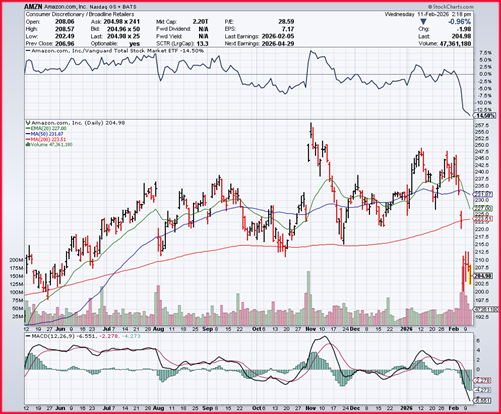
There is indeed a strange dichotomy in the stock market this year, where the stocks of companies deemed at long-term risk of disruption by Artificial Intelligence are falling at the same time as those powering the AI boom such as Amazon and Microsoft. Amazon, in particular, is an interesting case, as no part of its business – whether its globe-spanning retail operations or its cloud computing segment – is in any way threatened by AI (one could make the argument – which I disagree with – that Microsoft’s software businesses might be vulnerable long term to AI’s rapid advances in software coding). But if you believe the AI hype, which investors appear to at the moment, then Amazon’s stock should be a surefire winner. And yet it’s down almost 15% in the last 9 months.
Investors’ biggest concern is that Amazon is actually spending too much money building data centers to accommodate AI demand. I generally agree. For instance, from 2013-2019 Amazon increased its capital spending by $13 billion. Capital spending goes towards property, plant, and equipment which in Amazon’s case means things like data centers for its cloud operations and trucks and distribution centers for its retail business. Of that $13 billion increase, a reasonable approximation is that about half ($6.5 billion) went towards data centers. Over that same time period1 Amazon’s cloud business saw revenue grow from $4.6 billion to $45.4 billion. So the Company spent around $6.5 billion building data centers, which led to more than $40 billion in new cloud revenue. That’s pretty good!
In 2024 and 2025, however, AMZN’s capital spending increased an astonishing $80 billion. But revenue in its cloud business only grew about $54 billion. In 2026 Amazon’s capital spending is set to surge another $70 billion to an almost unfathomable $200 billion in total. Meanwhile, its cloud business revenue might expand about $40 billion as a result. So perhaps you can see the problem. Prior to 2020 every dollar Amazon invested in data centers was likely generating more than $6 in revenue ($40.8 billion revenue gain / $6.5 billion capital spending increase). But today $1 of data center spending is generating perhaps just $0.60-$0.70 in cloud revenue ($80 billion capital spending increase / $54 billion revenue increase).
The problem is that the capital required to support AI companies appears much higher relative to the revenue generated than in Amazon’s core, non-AI cloud business. Worse, most AI companies are still deeply unprofitable and depend on external financing, including venture capital and even credit from cloud providers such as Amazon itself! Unless the economics of this business change (specifically, AMZN is able to charge far more for AI compute), the Company could see its profit margin compressed over the next 5-7 years, as costs continue to escalate much faster than revenue.
So even though investors remain wildly optimistic about AI continuing to make inroads in the global economy, they’re rightfully less sanguine about the future profit margins of cloud computing companies like Amazon. That doesn’t, however, necessarily undermine the investment case for Amazon’s stock, especially once you consider the different scenarios of how the AI infrastructure splurge might play out. Specifically, if the economics of the AI industry improve dramatically, Amazon’s big bet will have paid off. If they don’t get better, Amazon will drastically cut its capital spending, likely boosting the stock price – much as Meta’s stock jumped when it finally reined in its virtual reality spending – as investors anticipate higher profit margins and stronger cash flow. The Company’s decision to spend big on data centers is an offensive, not defensive, move. Amazon’s competitive position in both retail and cloud computing remains as strong as ever and is unlikely to weaken anytime soon, regardless of how the economics of the AI industry evolve.
1 Note that I’m using a 12 month lag – i.e. I’m comparing capital spending from 2013-2019 and the associated revenue increase from 2014-2020